


NASA-created mosaic of asteroid Bennu showing its loose, rocky composition.
Photo: NASA

Pristine 4.3-ounce sample from asteroid Bennu, held within the sampling device in NASA lab.
Photo: NASA
By Kevin McKeon, Maine Master Naturalist
Last week’s column explored the life we see on our woods and trail walks, how it formed over the course of the planet’s evolution, and how it may have begun near primordial volcanic magma vents deep in the oceans. All the pieces for life’s birth are hypothesized to have been there at those vents-but from where and how did they arrive? Previous data gleaned from meteorites (asteroids that have hit Earth) reveal that most of life’s building blocks were present on these celestial visitors. So, did early cellular life at those vents bloom from material delivered by asteroids?
At the birth of our solar system, space dust formed rocks which condensed into larger rocks, forming planetesimals and the larger planets. These settled into gravitational-controlled orbits around the sun. The smaller planetesimals, further away from the Sun’s gravitational influence, aimlessly collided and broke apart to form the Asteroid Belt between Mars and Jupiter. The sun’s influence, along with Jupiter’s gravity, holds it together within its own solar orbit.
Occasionally, planetesimal collisions elsewhere result in asteroids that are able to avoid the belt. One of these collisions is believed to have happened in the outer solar system, possibly in the Kuiper Belt beyond Neptune where Pluto and other dwarf planets live. That collision is believed to have birthed Asteroid Bennu, which escaped the Kuiper Belt, avoided the Asteroid Belt, and set itself in a solar orbit diagonally from the planetary orbits. This ⅓-mile-wide asteroid occasionally crosses Earth’s orbit.
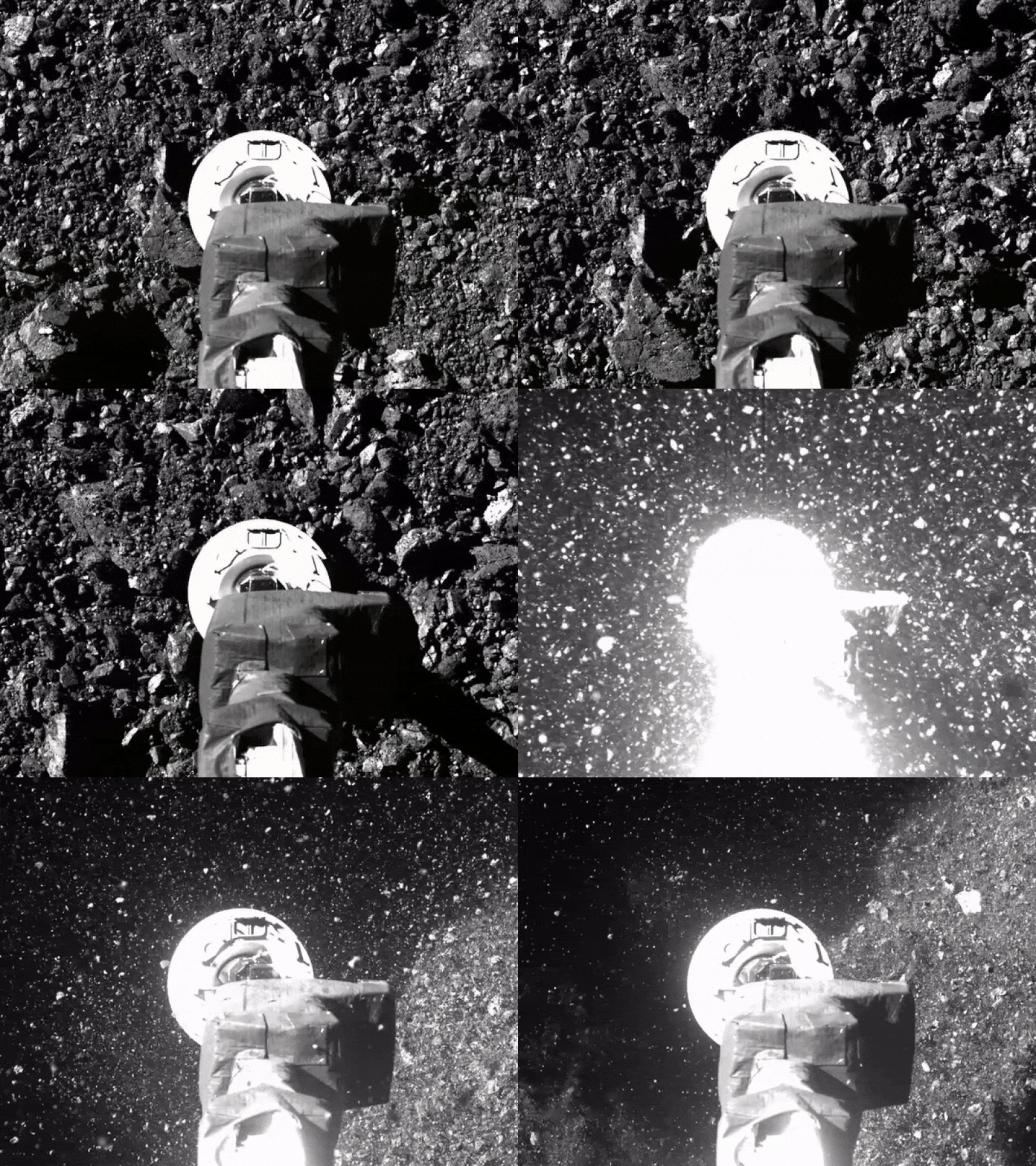
In 2016, an international, multi-disciplined asteroid sampling effort culminated in the launch of the spacecraft OSIRIS-REx. It rendezvoused with asteroid Bennu in 2018 and began a two-year, mile-high orbit, mapping Bennu’s surface by compiling and processing stereoscopic images. Key to this 3-D mapping project was Dr. Brian May, astrophysicist (and founder and lead guitarist of the rock group Queen!). Sample site “Nightingale” was thus identified and a 4.3-ounce sample was retrieved in 2020. OSIRIS-REx then began its 2½ year journey back to Earth.
In 2023, the module holding the sample was released into Earth’s atmosphere, parachuting to a feather-light landing onto Utah’s desert. After traveling 1.2 billion miles in seven years, NASA then sent OSIRIS-REx to a planned 2029 rendezvous with yet another asteroid, Apophis, under its new name, OSIRIS-APEX.
There are a few reasons for this next destination. Studies of meteorites that fell to Earth have found substances made from life’s building blocks, but contamination during their passage through the atmosphere makes the results uncertain. Pristine samples would allow scientists to better test theories about how asteroids formed and how their impacts affected planets and moons, including Earth. That is the goal of the OSIRIS missions. This video describes initial results from the data.
Also, according to NASA, “Studies of rock and dust from asteroid Bennu delivered to Earth by NASA’s OSIRIS-REx…have revealed molecules that on our planet, are key to life, as well as a history of saltwater that could have served as the “broth” for these compounds to interact and combine.” And the exciting part: “The findings do not show evidence for life itself, but they do suggest the conditions necessary for the emergence of life were widespread across the early solar system, increasing the odds life could have formed on other planets and moons.”
These peer reviewed studies, published in Nature Astronomyon Dec. 2, 2025, support an explanation that the source of life on Earth could have come from asteroid impacts, which contained life’s basic building blocks.
The sample also revealed two types of sugars key to biological molecular development: Ribose, needed for RNA and DNA; and glucose, needed for cellular energy and ATP production. Also, within the sample was “pre-solar dust” — stardust that existed outside our solar system before our solar system was formed — holding at least 14 of the 20 amino acids that life on Earth uses to make proteins. Still another finding: All five nucleobases — the “A”, “C”, “G”, “T”, and “U” we see on RNA/DNA images, responsible for RNA’s and DNA’s helical chain-structure building — were also in the sample. Also, carboxylic acids (other life building blocks) were isolated in the Bennu sample. These sugars, nucleobases, and amino and carboxylic acids indicate that the required substances for biological molecular life-building processes were spread throughout the solar system and delivered to planets and moons via asteroids.
Another finding from Bennu’s sample is the presence of relatively high amounts of ammonia, and levels of formaldehyde. The two can react to form amino acids and other rather complex molecules which can combine to form proteins that energize almost all biological functions.
Also, a polymer-like material dubbed “Space Gum” was on space rocks for the first time ever. It is rich in nitrogen and oxygen and could have aided with various chemical formations adding to possible life-building processes.
Thousands of molecules containing carbon and hydrogen add to the findings, together showing that everything needed to form life was present 4.5 billion years ago on Bennu — an asteroid from the outer solar system. This leads to the conclusion that during the formation of our solar system, the building blocks of life as we know it were crashing into all the forming planets and moons and are still doing so today.
The second reason for this mission to Bennu: NASA considers Bennu the most dangerous rock in the Solar System, with the highest probability of hitting Earth than any other known asteroid. It passes near Earth every six years, and there is a very small chance of an Earth strike between now and 2300. In 2135, it’ll be closer to us than the moon, so a study of its composition is obviously warranted. For comparison: Asteroid Chelyabinsk exploded 14 miles high in Earth’s atmosphere, blew out windows 200 miles away, and injured over 1,600 people in Russia. It was the size of a house. Bennu is ⅓ mile wide! Concerns for such impacts led NASA to establish the Planetary Defense Coordination Office in 2016 with a mission of finding, tracking, and studying asteroids and comets that could pose such threats. See monthly updates here. Within this Office are the Near-Earth Object Observations Program, and various other planned and ongoing planetary defense flight missions, including a 2027 spacecraft launch carrying a telescope, the NFI Surveyor, specifically designed to detect near earth objects.
Sample retrieval: https://science.nasa.gov/wp-content/uploads/2023/05/osiris-rex-touchdown-on-bennu.gif
Initial results: https://cdn.jwplayer.com/previews/5DFbwTXi
NASA Article: https://www.nasa.gov/news-release/nasas-asteroid-bennu-sample-reveals-mix-of-lifes-ingredients/
Bennu/Earth Collision study: https://www.science.org/doi/10.1126/sciadv.adq5399
NEO updates: https://science.nasa.gov/science-research/planetary-science/planetary-defense/near-earth-asteroids/
NEO Surveyor: https://science.nasa.gov/mission/neo-surveyor/

The post Asteroids Offer Scientists Clues to Life on Earth appeared first on Sanford Springvale News.